


YOUNG WOMEN , PEACE, AND SECURITY IN AFRICA
- infor245
- Aug 16, 2022
- 7 min read
INTRODUCTION
Since the end of the Cold War, humanity has faced many security challenges, with heavy consequences on the population. The focus of war has shifted from inter-state to intra-state conflicts, and the needs and issues that affect individuals are now at the center of international discussions. In recent decades, Africa has been on the scene of violent conflicts that have undermined its peace and security. In such a context, the consequences of conflicts affect both men and women to different degrees with Women paying a heavy price for conflicts.
With the impact of conflicts on women, the international community, through the adoption of Resolution 1325, has marked a decisive turning point in peace and security issues by allowing women to participate in the various peace processes. This resolution has been accepted and integrated into the peace and security context of Africa, through a fairly rich normative arsenal that takes into account women and the impact of conflicts on them in order to achieve a sense of lasting peace and thus put an end to conflicts.
Nevertheless, the inclusion of women alone does not guarantee an effective peace process, given the changing role of young women in conflicts as victims but also as actors of violence. It is therefore appropriate in the context of this document to talk about the meaningful and useful participation of women in peace and security in Africa.

However, most peace processes do not include women. Global trends show little progress since 2000. From 1992 to 2019 women constituted 13% of negotiators and 6% of signatories in major peace processes. (Avonius, et al. 2018). Priority is rarely given to developing women’s individual and collective capacity to address these conflicts and to build stable, peaceful, and democratic institutions in Africa. Women generally remain absent from policy dialogue with the government on critical issues for peace and security that have fundamental gender dimensions and implications for sustainable stability. 22 years later after the adoption of the resolution1325, where are women in peace and security in Africa? This paper seeks to analyze the role of women in peace and security and the obstacles constraining women from meaningful participation in peace in Africa.
I . Why have young women in peace and security?
According to (Bell & O'Rourke, 2010) the exclusion of women from the peace process is a threat to the peace itself.
In the year 2000, the United Nations Security Council (UNSC) implemented a new resolution called UNSC Resolution 1325 concerning women, peace, and security. The resolution consists of four ground pillars which are prevention, participation, protection, and peacebuilding and recovery. The resolution was adopted to establish the important roles women play in the prevention and resolution of conflict, both in negotiating for and building peace (UN Women, 2016). Why is it then important to have women in the peace process as meaningful agents of peace?
First, Having women as a mediator breaks the ice between parties in the negotiation. When a mediator women have an intimate knowledge of the situation on the ground, gets to know the context, travels, visits affected communities, and invests time in nurturing relationships with civil society, it helps mitigate the effects of conflict in society (Avonius, et al. 2018). Women negotiators also bring another perspective to the table. They are aware of women's needs and afflictions after the war and can contribute to the knowledge on issues of their daily life, and take those needs as a matter of priority in the process of rebuilding society.
Secondly, as noted by Ghittoni et al. (2018), one of the reasons why women are included in peacekeeping missions is their ability to obtain information and to reach out to women. Especially in areas that might not be easy for men to access. So information Gathering is another key role women can be useful for and this is also important due to the fact that, if all the aspects of a conflict are not addressed and if the conflict is not well understood, it is obvious that any peace talk or process that will be initiated will definitely not guarantee lasting peace.
Thirdly, Dharmapuri (2011) and Ghittoni et al. (2018), argued that women enable building a strong relationship with the local population while working with them in conflict mitigation or conflict prevention. Literature also advocates women’s participation in peace and security with regard to interaction with the local population referring to women’s compassion which encourages them to easily interact with the locals.
Moreover, it is a great responsibility for women to take action to help female victims of sexual violence. This is corroborated by Kenny (2016) when he noted that one of the roles women play in peace and security is their unique access to women affected by sexual exploitation. It is obvious that no one can ignore that sexual violence is a huge consequence most women face in conflict time. Due to the fact that it is not easy for women victims of sexual violence to openly discuss with a male on such matter, having women in peacebuilding, peacekeeping, or even in a mediation team, is a meaningful step toward peace restoration. Women are seen as better respondents to victims of sexual violence.
Women can also engage in local-level conflict resolution initiatives; advocate for inclusion in post-conflict, and advocate for gender equality.

Advantages of having women on issues related to peace and security
This part will mostly emphasize, through example, the positive impact of women’s meaningful participation in the peace process either by self-implication or facilitation from a peace team.
During Kenya’s post-electoral violence in 2008, the mediator Kofi Annan, Chair of the Panel of Eminent African Personalities, along with his fellow panel member, Graça Machel, facilitated women's access to the negotiations. They encouraged women to draft recommendations for the peace process, which were subsequently presented to the Kenyan National Dialogue and Reconciliation Committee charged with negotiating the terms of the peace agreement.
The example of local women’s groups in Liberia staging mass demonstrations in 2003 and demanding an end to the war and killing is perhaps the best-known case of this occurring (UNMIL 2008 and Heinrich-Böll-Stiftung & Scheub 2012). The women’s groups were able to use their ‘women power’ to force a meeting with President Charles Taylor and to extract his promise to attend peace talks in Accra. A delegation of Liberian women went to Accra to put pressure on the warring factions during the peace talks. They staged a sit-in outside the venue for the negotiations, blocked all the doors, threatened to strip naked, and prevented anyone from leaving the peace talks without a resolution being reached.
One example of how women can use existing power structures to ensure their participation comes from the 1999 Arta peace talks in Somalia. In Somalia, women have traditionally been excluded from the political sphere. The 1999 peace talks reflected this: participation was limited to male elders from the five traditionally dominant Somali clans, who intended to model the peace process structure on that of traditional Somali clans, de facto excluding women. To avoid this, 92 of the 100 female delegates present formed the so-called ‘sixth clan’, a joint women’s coalition allowing them to transcend clan hierarchies and vote as a single block. This clan was able to ensure that 25 seats were reserved for women in the 245-member Transitional Assembly for women and also negotiated gender-sensitive provisions to protect the human rights of children, women, and minorities.
Current international practices also suggest that including a gender advisor in mediation teams is useful and strategic, as it helps to ensure women’s perspectives get taken into account in the actual peace negotiations (UN Women 2012; Reimann et al. 2012).
Despite the obvious and meaningful roles and advantages, women bring in peace and security, their absence continues to be a fact that is affecting conflict resolution initiatives.
II. Why are women still absent in Peace and security in Africa?
There are various factors accounting for the low representation of women in Peace and security in Africa.
Physical Conditions
As noted by Ghittoni et al. (2018), physical fitness test constitutes one of the barriers that prevent women from being in peacekeeping operations for instance. Indeed peacekeeping missions entail strength and fitness criteria that women find difficult to meet.
Family Constraints Patriarchy: factors that prevent women from being counted in peacekeeping missions and peace processes have their background in society. Indeed family constraints especially in terms of how to conciliate the professional and the maternal role are an equation that is difficult to solve.
Patriarchy: Aside that Malešević’s view (2010) on patriarchy can also explain the low representation of women in peace and security. He noted that a society based on deeply rooted patriarchal beliefs will always see warfare or peacekeeping operations, and the peace processes as made for men, while mothering and caring are for women. Patriarchy, therefore, reinforces the gender roles within which, family responsibilities better suit women.
Security Risk: According to research one of the challenges faced by women in Peacekeeping operations is the security risk. Being in peacekeeping is always dangerous.
A male-dominated environment
One of the main challenges women face in entering the military is that they are entering a highly gendered environment, dominated by hegemonic masculinity (Carreiras & Kummel, 2008; Whitworth, 2004).
III. What can be done for a meaningful representation of women in peace and security?
Based on the challenges women face in the field of peace and security, some recommendations can be made :
- Reinvigorate women's peace and security networks to enable women interested in peace and security to have the motivation to be perpetual agents of peace at both the local and national levels
- Strengthen the leadership of women peacemakers so that they can realize their full potential to intervene in conflict mitigation
- International institutions must also accompany women's organizations working in peace processes by identifying the different axes on which to act
- Strengthen the capacities of members of women's peace and security organizations on the challenges in the field of peace and security as well as the tools necessary to carry out their mission as peace actors.
- Highlighting women who have made important contributions to peace in Africa to share experiences among women.

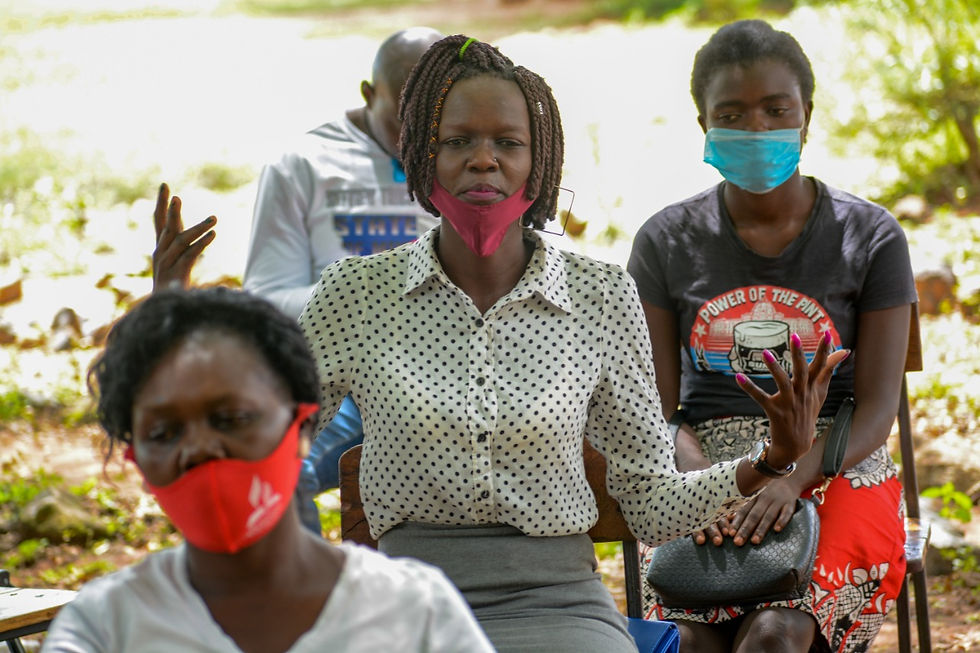
DNM participants of Cohort 2 in Kisumu, Kenya with Ms. Orao-DNM's long-term TOT
Conclusion
Women are not merely passive victims, but also important agents and actors in the peace processes in Africa. Even though various factors prevent them from showing their full potential for the success and effectiveness of every peace process in Africa, it is high time to consider their meaningful contribution based on what few of them were able to do by breaking the social barriers.
As stated by Tickner (1992):
Even if a better future is not female, a human future that rejects the rigid separation of public and private values and the social distinctions between women and men requires that the good qualities of both are equally honored and made available to all.
Researched and Written by: Estelle Kouessiba DJANATO
Research officer, WOVOP
Reviewed and published by: Grace Orao
Executive Director, WOVOP


Comments